Angelo Nardi
I Know This Much Is TrueAngelo Nardi is a displaced courtroom stenographer from Palermo whose attempt to help Domenico Onofrio Tempesta write his life story brings him into the household of Ma, Domenico’s daughter. He is remembered as handsome, clever, and promising, but the collaboration ends in repeated quarrels and Angelo’s departure for the Chicago area. Years later, his visits and Ma’s warm recollections make him one of Dominick Birdsey’s suspects in the mystery of his parentage. The book never confirms that suspicion: Angelo matters both as a participant in a failed family-history project and as a possible father whom Dominick’s longing gradually turns into an imagined rescuer.
Identity and Arrival
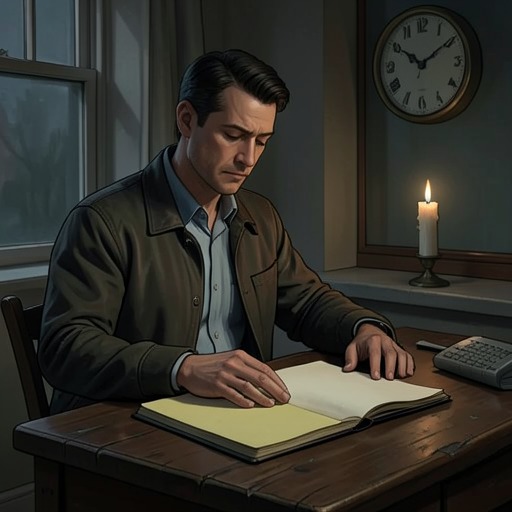
Angelo had come from Italy after the war and had worked as a courtroom stenographer in Palermo. When he arrived in the Birdsey family’s story, he was looking for work. Ma remembered him as a “handsome fella” who was “very dashing”; she also recalled that he was smart and quick to grasp the English she helped him with. Their conversations in the kitchen touched on his life in Palermo and his family, though the narrative gives no further account of either.
Angelo’s arrival was connected to Domenico’s long-held wish to tell his life story. Domenico imagined that boys and young men in the old country would want to read how one of their own had come to America and prospered. Angelo’s skill as a stenographer appeared to offer a way to turn that ambition into a book. The assignment placed him close to a private family history, but it did not make him a member of the family, and the story leaves the boundaries of his relationship with Ma uncertain.
The Autobiography Project
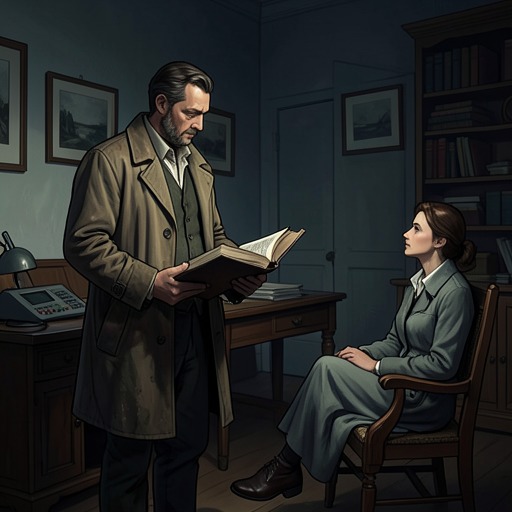
Domenico initially spared no expense on the project. He cleared furniture from the parlor and rented a typewriter for Angelo. The work soon acquired strict conditions: each morning Angelo set things up, then left Domenico alone to dictate. Domenico would not speak until he had privacy. Ma remembered Angelo waiting in the kitchen while her father recorded his account elsewhere in the house.
For a time, Domenico dictated onto a Dictaphone with red plastic belts. After he finished, Angelo brought the recording to the back room, took it down in shorthand, and typed it. The arrangement accommodated Domenico’s need to speak alone and his dislike of hearing the typewriter after dictation, when the work of remembering had left him cranky. It also made Angelo’s role dependent on access to a story whose limits Domenico controlled.
The process broke down when Domenico returned to dictating directly to Angelo. He began accusing the stenographer of probing into matters he had chosen not to explain and of changing his words to make him look bad. The dispute was not simply over typing or transcription: it concerned who could ask questions, what could be recorded, and whether another person could shape Domenico’s account. Angelo became fed up, and the two men fought repeatedly.
Domenico fired Angelo in the middle of July, cooled down after a few days, and rehired him. The reconciliation lasted only until the following day, when Domenico fired him again. When Domenico tried to hire him back a second time, Angelo refused. He moved to the Chicago area soon afterward. He and Ma exchanged one letter each, after which their correspondence ended. Following the failed collaboration, Domenico went into the backyard and wrote the rest of his story himself.
Ma and the Family’s Unanswered Question
Angelo’s connection to Ma is established through ordinary, concrete details: he waited in the kitchen, she made him coffee, they talked, and she helped him with English. These encounters gave Dominick a basis for imagining a more consequential relationship, but the account does not establish that one existed. Ma’s account of Angelo’s work and departure is not a revelation of the twins’ parentage.
From childhood, Dominick entertained theories about who his “real” father might be. By the time Ma died, he had settled on Angelo as his chief suspect. The theory rested in part on his being an Italian newcomer who had spent time around Ma while working at her father’s house, and on Ma’s admiring description of him. Dominick himself recognized the distinction between suspicion and knowledge: Angelo might be the father, but the possibility remained only a theory.
When Dominick later tells Dr. Patel about the manuscript, he again identifies Angelo as his leading suspect while choosing not to explain the theory. He describes Angelo as the stenographer who had come from Italy after the war, and recalls Ma’s account of Domenico dying from a stroke while reading the manuscript in the backyard, its pages blowing across the yard. Angelo’s part in the project is therefore recalled alongside the family’s lost history, but the manuscript’s completion and Domenico’s death do not resolve the paternity question.
The Father Dominick Imagines
After Thomas Birdsey’s funeral, Dominick returns in memory to the summer when Domenico wrote his confession. He thinks again of Angelo’s hiring, firing, and failed rehiring, and wonders what the stenographer made of Domenico’s contradictory desire to speak and keep silent. He also speculates about what Angelo thought of Ma, whom Dominick describes through the circumstances of her life in her father’s home. These are questions Dominick asks himself, not facts the narrative confirms about Angelo’s motives or conduct.
In the same recollection, Dominick considers two sharply different possibilities: Angelo might have exploited Ma’s vulnerability, or might have shown her tenderness. As he prepares for Thomas’s funeral, he chooses the kinder version in imagination, making Angelo a merciful man rather than a creep. This is an act of wishful revision, not recovered evidence. Dominick then imagines Angelo appearing at the cemetery as a dignified older man, apologizing for having missed Thomas’s life and promising to be present for Dominick. He imagines forgiving him immediately. The scene belongs to Dominick’s fantasy; no return or reunion occurs.
The fantasy brings Angelo’s significance into focus. For Dominick, the absent father is not only a question of biological identity but also a figure who might have protected him and remained available. Even at forty-one, after Thomas’s death, Dominick recognizes that he is still looking for such a father. Angelo remains a mystery because the book supplies no confirmation of his paternity and no later account of his life. What it does show is how a few remembered encounters, a failed manuscript project, and Ma’s praise become material for Dominick’s enduring hope.